What Does Automation Mean? A Complete Guide to Understanding Modern Automation
Estimated reading time: 10 minutes
Key Takeaways
- Definition of Automation: Technologies that enable self-operating processes with minimal human involvement.
- Evolution & Types: From mechanical levers to AI-powered systems, automation spans fixed, programmable, flexible, and integrated approaches.
- Sector Impacts: Revolutionizes business productivity, healthcare accuracy, and manufacturing consistency.
- Pros & Cons: Offers efficiency and safety but brings initial costs and workforce challenges.
- Future Outlook: Driven by AI, IoT, and collaborative robotics; emphasizes skill development and adaptation.
Table of Contents
- Understanding Automation: The Basic Definition
- The Evolution of Automation
- Types of Automation
- The Impact of Automation on Different Sectors
- Advantages and Disadvantages of Automation
- The Future of Automation
- Preparing for an Automated Future
- Conclusion
- Frequently Asked Questions
Understanding Automation: The Basic Definition
At its core, automation refers to the creation and application of technologies that produce and deliver goods and services with minimal human intervention [Source].
It’s the technique of making processes or facilities self-operating, essentially allowing machines and systems to work independently with reduced human involvement [Source].
The Evolution of Automation
From *ancient water clocks* to *modern AI-driven robots*, the journey of automation highlights humanity’s constant quest for efficiency. What began as simple mechanical contraptions has grown into complex, interconnected systems that underpin industries worldwide.
- Early Mechanical Automation (pre-1900s)
- Industrial Revolution Automation (1800s)
- Digital Automation (1950s–present)
- AI-Powered Automation (Current era)
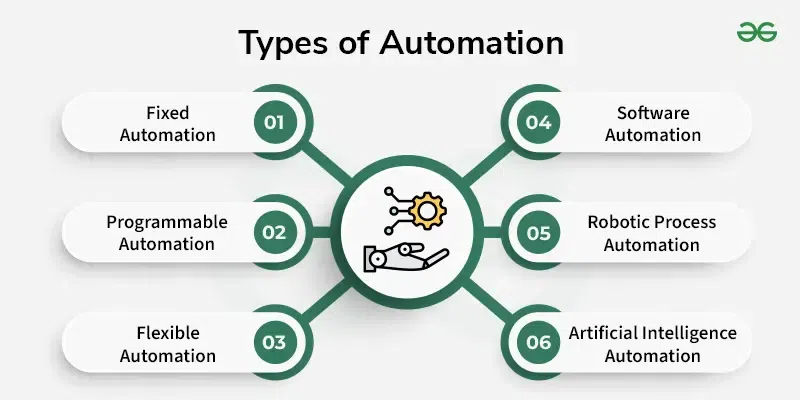
Types of Automation
Modern automation can be categorized into several key types [Source]:
- Fixed Automation: Designed for specific, repetitive operations; high production rates but inflexible to variations.
- Programmable Automation: Handles different product configurations and batch production; can be reprogrammed for new tasks.
- Flexible Automation: Merges fixed and programmable benefits; allows quick switching between products with minimal downtime.
- Integrated Automation: Encompasses planning, transport, storage, and quality control under advanced computer systems.
The Impact of Automation on Different Sectors
Business and Industry
Automation has revolutionized how businesses operate [Source]. It has:
- Increased productivity and efficiency
- Reduced operational costs
- Improved quality control
- Enhanced workplace safety
- Enabled 24/7 operations
Healthcare
In the medical field, automation has led to [Source]:
- More accurate diagnostic procedures
- Improved patient monitoring systems
- Streamlined administrative tasks
- Enhanced drug dispensing systems
- Better record-keeping
Manufacturing
The manufacturing sector has seen dramatic change [Source]:
- Increased production speed
- Better product consistency
- Reduced waste
- Improved workplace safety
- Lower production costs
Advantages and Disadvantages of Automation
Advantages
Key benefits include [Source]:
- Increased Productivity: Higher output rates, consistent quality, reduced production time.
- Enhanced Safety: Fewer workplace accidents, handling hazardous materials.
- Economic Benefits: Lower operating costs, improved resource utilization.
- Quality Improvements: Consistent products, reduced human error.
Disadvantages
- Initial Cost: High installation, training, and maintenance expenses.
- Job Displacement: Potential layoffs, need for retraining.
- Technical Limitations: Complex troubleshooting, system failures, updates.
The Future of Automation
- AI Integration: Machine learning, natural language processing, adaptive systems [Source].
- Collaborative Robotics: Human-robot interaction, flexible automation, smart factories.
- Internet of Things (IoT): Connected devices, real-time monitoring, predictive maintenance.
Preparing for an Automated Future
- Skill Development: Technical literacy, system understanding, problem-solving abilities.
- Education and Training: Continuous learning, professional development, cross-functional skills.
- Workplace Adaptation: Embrace new tools, understand automation platforms, cultivate complementary expertise.
Conclusion
Automation transcends mere robotics; it’s a holistic strategy to boost efficiency, safety, and innovation across sectors. While challenges like initial investment and workforce shifts exist, the *transformative advantages*—from higher productivity to improved quality—are clear. By embracing ongoing learning and fostering collaboration between humans and machines, we can harness automation’s full potential and thrive in an increasingly automated world.
Frequently Asked Questions
What is the core purpose of automation?
The primary goal is to streamline processes by reducing manual intervention, thereby increasing efficiency, consistency, and safety.
How does automation affect employment?
While automation can displace certain roles, it also creates opportunities in system design, maintenance, and oversight—emphasizing the need for workforce retraining.
What are the biggest challenges in implementing automation?
Key obstacles include high initial costs, technical complexity, and the requirement for skilled personnel to manage and troubleshoot systems.
How can businesses prepare for future automation trends?
Organizations should invest in continuous learning programs, foster cross-disciplinary teams, and pilot emerging technologies to stay ahead of the curve.