Agentic AI: The Rise of Autonomous AI Systems That Act on Your Behalf
Estimated reading time: 8 minutes
Key Takeaways
- Agentic AI refers to AI that can act autonomously on a user’s behalf.
- Core traits include autonomy, goal-oriented behavior, and persistence.
- Applications span business automation, cybersecurity, and R&D with transformative potential.
- Key challenges involve ethics, technical integration, and governance.
Table of Contents
- Understanding Agentic AI
- What Makes AI “Agentic”?
- The Core Components of Agentic AI
- Real-World Applications
- Benefits and Advantages
- Challenges and Considerations
- Future Prospects
- Best Practices for Implementation
- Conclusion
- Frequently Asked Questions
Understanding Agentic AI
The world of artificial intelligence is witnessing a revolutionary shift with the emergence of agentic AI—autonomous systems designed to act independently on behalf of users. These systems reshape our interaction with digital platforms and transform industries.
Definition and Evolution
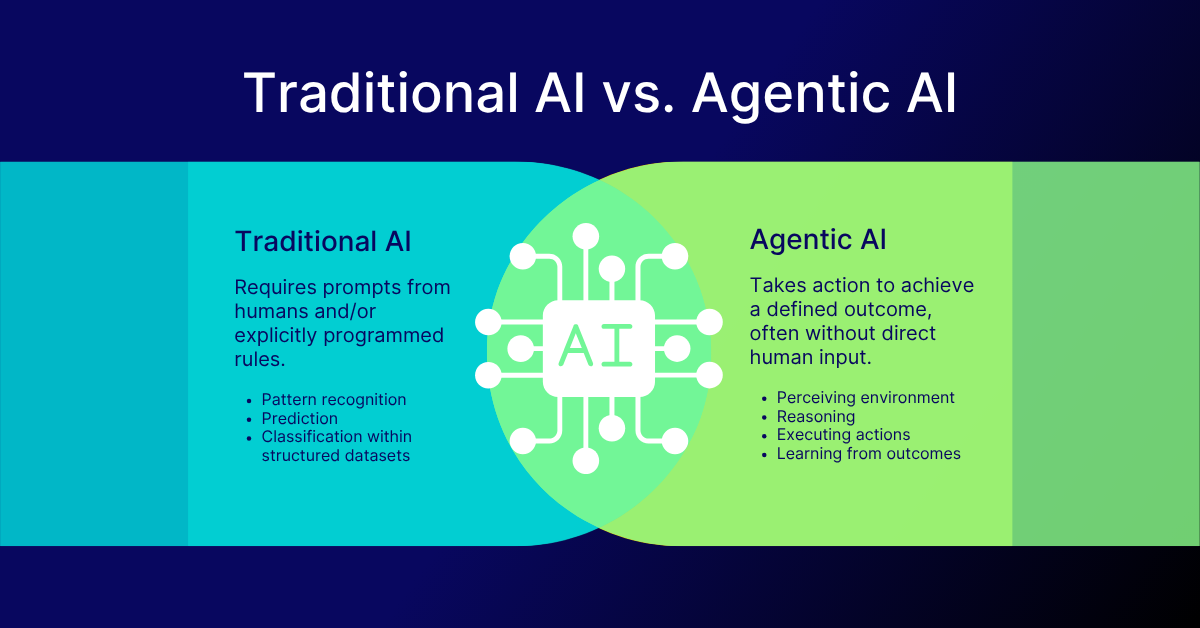
Agentic AI represents a significant leap from traditional AI. Instead of merely responding to commands, these agents:
- Demonstrate initiative
- Exhibit persistence in goal completion
- Understand context and adapt to changing scenarios
What Makes AI “Agentic”?
According to IBM’s research, an AI system becomes agentic when it exhibits three key characteristics:
1. Autonomy: Operates with minimal human intervention
2. Goal-oriented behavior: Works towards specific objectives
3. Persistence: Continues efforts until goals are achieved
The Core Components of Agentic AI
The University of Cincinnati identifies essential modules:
- Perception modules for environmental understanding
- Decision-making algorithms
- Action execution capabilities
- Learning mechanisms for continuous improvement
- Goal management systems
Real-World Applications
1. Business Process Automation
As outlined by MIT Sloan Management Review, companies leverage agentic AI to:
- Automate complex workflows
- Manage resource allocation
- Optimize supply chain operations
- Handle customer service interactions
2. Cybersecurity
Research from Exabeam highlights:
- Autonomous threat detection
- Real-time response to security incidents
- Predictive analysis of vulnerabilities
- Continuous system monitoring
3. Research and Development
The National Center for Biotechnology Information reports applications in:
- Drug discovery
- Scientific data analysis
- Experiment design and optimization
- Literature review and synthesis
Benefits and Advantages
AWS documentation outlines:
- Enhanced Efficiency: Reduced human intervention, faster decisions, 24/7 operations
- Improved Accuracy: Consistent performance, reduced errors, data-driven decisions
- Scalability: Multitasking, easy deployment, workload adaptability
Challenges and Considerations
MIT’s CSAIL research (CSAIL) highlights:
- Ethical considerations: transparency, accountability, privacy
- Technical challenges: reliability, integration, performance monitoring
- Implementation barriers: cost, training, change management
Future Prospects
Recent research on arXiv suggests upcoming advances in:
- Sophisticated decision-making
- Advanced learning algorithms
- Human-AI collaboration
- Broader industry adoption
Best Practices for Implementation
According to Acceldata, organizations should:
- Start Small: Pilot projects, focus use cases, scale gradually
- Ensure Governance: Clear guidelines, performance monitoring, human oversight
- Prioritize Security: Robust measures, audits, data protocols
Conclusion
Agentic AI marks a leap forward in how we interact with intelligent systems. Its autonomy, goal-directed behavior, and persistence unlock new efficiencies across industries. Yet, success demands careful ethical, technical, and governance considerations. As research and real-world deployments advance, agentic AI will play a defining role in the future of human-AI collaboration.
Frequently Asked Questions
What is agentic AI?
Agentic AI refers to autonomous systems that act independently on a user’s behalf, exhibiting autonomy, persistence, and goal-oriented behavior.
How does agentic AI differ from traditional AI?
Traditional AI responds to commands, whereas agentic AI takes initiative, adapts to context, and pursues objectives without constant human input.
What industries benefit most from agentic AI?
Key sectors include business automation, cybersecurity, and research and development, with expanding applications in healthcare, finance, and logistics.
What are the main challenges of implementing agentic AI?
Challenges encompass ethical concerns, integration complexities, cost, and ensuring robust governance and security.