Robotic Process Automation: The Digital Workforce Revolution Transforming Business Operations
Estimated reading time: 8 minutes
Key Takeaways
- RPA automates routine tasks to boost accuracy and efficiency.
- Seamless integration with existing systems without heavy IT overhauls.
- Scalable and cost-effective solution for businesses of all sizes.
Table of Contents
- What is Robotic Process Automation?
- The Core Components of RPA
- Business Applications and Benefits
- Common Use Cases for RPA
- Implementation Considerations
- Future Trends in RPA
- Best Practices for Success
What is Robotic Process Automation?
_In today’s fast-paced digital landscape, Robotic Process Automation has emerged as a groundbreaking technology revolutionizing how businesses operate._
RPA uses software robots or “bots” to mimic human actions—clicking, typing, copying and pasting data, and navigating applications—without the need for physical machinery. These digital workers operate within the virtual environment, seamlessly interacting with existing systems to automate routine, rule-based tasks.
The Core Components of RPA
Software Robots
These digital workers execute tasks with precision, consistency, and without fatigue. They can operate 24/7, making them ideal for repetitive processes. ([Source])
Rule-Based Processing
RPA bots follow predefined rules and logic, making them perfect for high-volume, time-sensitive, and error-prone tasks that rely on structured data.
Integration Capabilities
One of RPA’s strengths is its ability to integrate with existing applications without requiring complex changes to underlying infrastructure. ([Source])
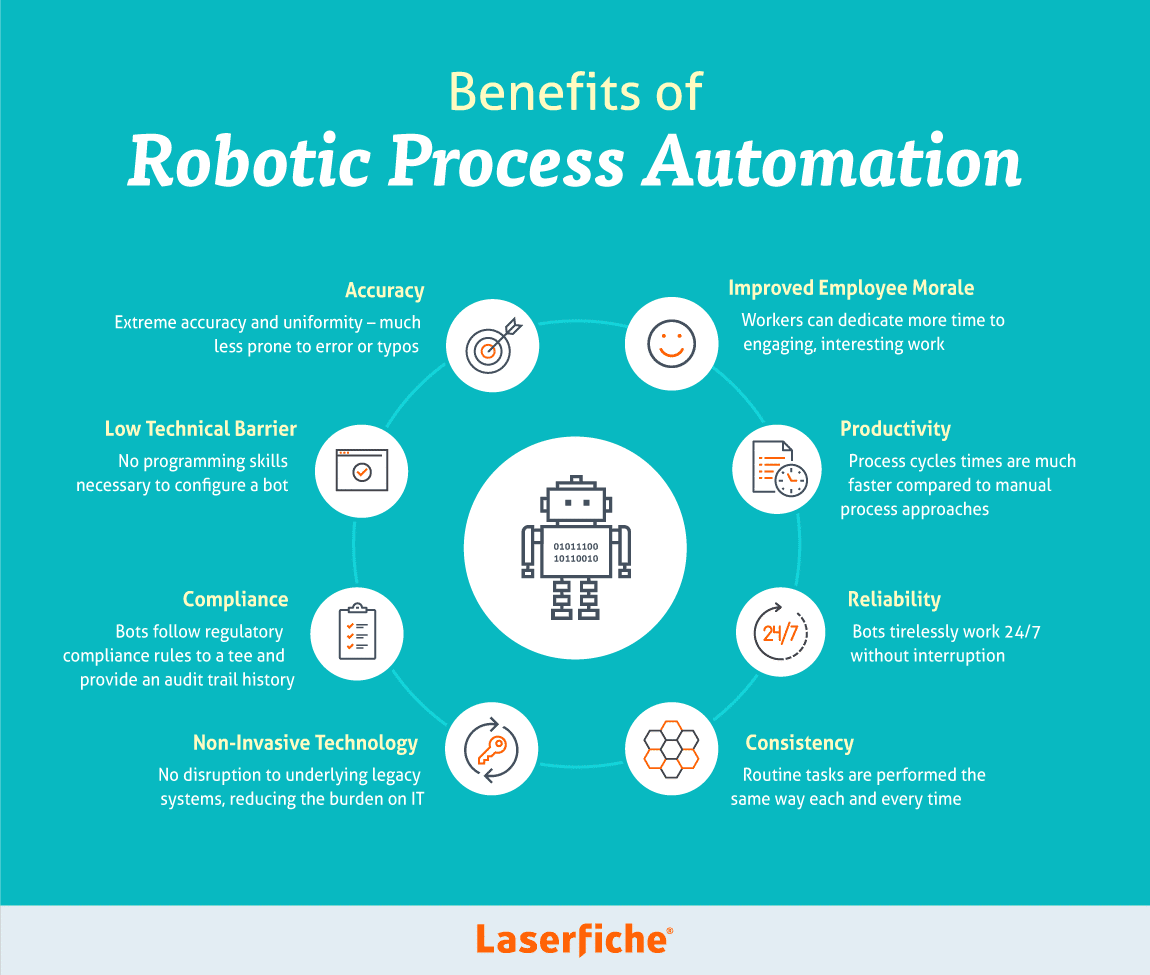
Business Applications and Benefits
Cost Reduction
By automating routine tasks, organizations can significantly reduce labor costs while boosting productivity. ([Source])
Improved Accuracy
RPA bots perform tasks with 100% accuracy, eliminating human errors and ensuring consistent outcomes. ([Source])
Enhanced Productivity
Bots can work non-stop, handling the workload of multiple full-time employees without breaks. ([Source])
Better Customer Experience
Automating backend processes ensures faster, more accurate service delivery, leading to higher customer satisfaction.
Common Use Cases for RPA
- Data entry and processing: form filling, validation, report generation, invoice processing.
- Customer service operations: email response automation, data updates, order processing, account management.
- HR processes: payroll, employee onboarding, benefits administration, attendance tracking.
- Financial operations: account reconciliation, purchase order processing, expense management, financial reporting.
Implementation Considerations
Before deploying RPA, organizations should evaluate:
- Process Selection: Ideal candidates are highly standardized, rule-based, high-volume, with structured data inputs. ([Source])
- Change Management: Clear communication, training, expectation management, and continuous monitoring are critical.
- Security and Compliance: Ensure access controls, audit trails, and adherence to regulatory requirements.
Future Trends in RPA
- AI Integration: Combining RPA with machine learning to handle complex, decision-based tasks. ([Source])
- Cognitive Automation: Bots that process unstructured data, learn from patterns, and adapt to new conditions.
- Cloud-Based RPA: More accessible, scalable solutions hosted in the cloud.
- Hyperautomation: End-to-end automation using multiple technologies like RPA, AI, and process mining.
Best Practices for Success
- Start Small: Pilot projects focusing on simple, high-impact processes.
- Ensure Quality: Rigorous testing, performance monitoring, and documentation.
- Build Internal Expertise: Train staff, develop in-house capabilities, establish a center of excellence.
- Measure and Optimize: Track KPIs, monitor ROI, and continuously improve processes.
Frequently Asked Questions
What industries benefit most from RPA?
Industries with high-volume, repetitive tasks—such as finance, healthcare, and manufacturing—often see the greatest ROI from RPA deployments.
How long does it take to implement RPA?
Implementation time varies, but pilot projects can be live within weeks, while enterprise-wide rollouts may take several months.
Can RPA work with legacy systems?
Yes. One of RPA’s advantages is its ability to interface with legacy applications via the user interface, avoiding complex integrations.
What are the risks associated with RPA?
Risks include security vulnerabilities, process changes without proper governance, and potential job displacement. Mitigation requires robust planning and compliance measures.