Agentic AI vs Traditional Automation: A New Era of Intelligent Systems
Estimated reading time: 8 minutes
Key Takeaways
- Autonomous Decision-Making vs rule-based execution.
- Dynamic Learning and continuous adaptation.
- Real-World Impact across customer service, manufacturing, and data analysis.
- Scalability, efficiency, and human collaboration enhancements.
Table of Contents
- Understanding the Fundamentals
- Key Differentiating Factors
- Real-World Applications
- Impact on Business Operations
- Future Implications
- Challenges and Considerations
- Conclusion
- Frequently Asked Questions
Understanding the Fundamentals
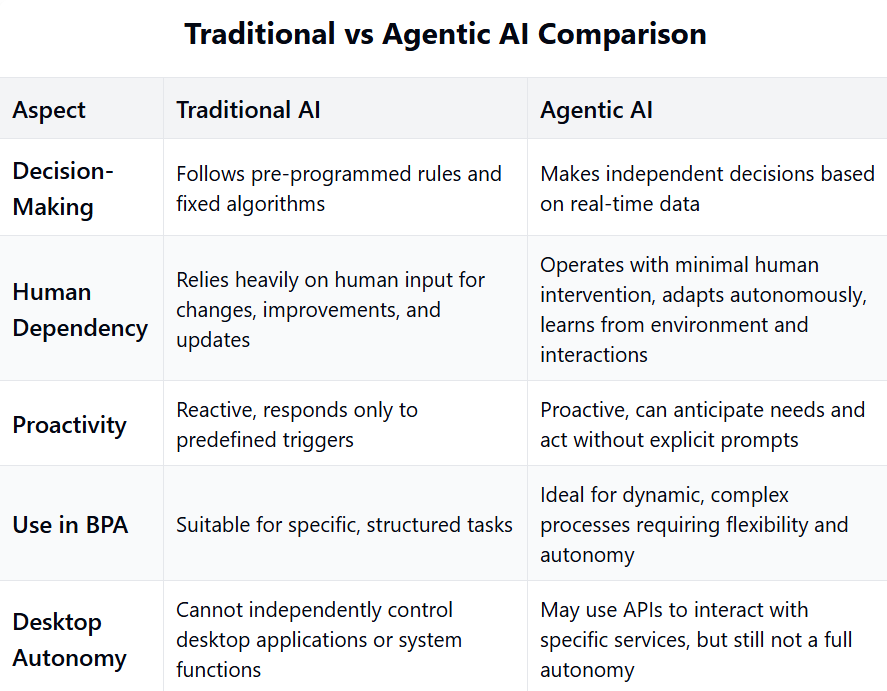
Traditional automation operates on pre-defined rules, following specific instructions to complete tasks in a predictable, linear fashion. Think of it as a well-oiled machine that excels at repetitive tasks but lacks the ability to adapt or make decisions outside its programming traditional automation vs generative AI vs agentic AI: when use which. [Source]
Agentic AI is designed to act as an autonomous agent, capable of understanding context, learning from experiences, and making independent decisions to achieve specified goals what is agentic AI. [Source]
Key Differentiating Factors
Decision-Making Capabilities
- Traditional Automation: Follows fixed rules and predetermined pathways; cannot handle exceptions outside programmed scenarios; requires manual updates for new situations.
- Agentic AI: Makes autonomous decisions based on context; learns from experience and adapts; can handle complex, unpredictable scenarios. [Source]
Flexibility and Adaptability
The contrast is like trains on tracks versus skilled drivers navigating various roads, traffic conditions, and unexpected obstacles. [Source]
Learning Capabilities
- Traditional Automation: Static programming; no real-time learning; manual updates required.
- Agentic AI: Continuous learning from interactions; self-improvement over time; dynamic adaptation to new circumstances. [Source]
Real-World Applications
-
Customer Service
- Traditional Automation: Basic chatbots with predetermined responses.
- Agentic AI: Intelligent assistants that understand context, learn from conversations, and provide personalized solutions.
-
Manufacturing
- Traditional Automation: Fixed assembly line processes.
- Agentic AI: Adaptive manufacturing systems that optimize processes in real-time.
-
Data Analysis
- Traditional Automation: Predefined data processing workflows.
- Agentic AI: Dynamic analysis systems that identify patterns and adjust strategies accordingly.
Impact on Business Operations
Efficiency Improvements
- Traditional Automation: Consistent but limited efficiency gains.
- Agentic AI: Exponential improvements through continuous learning and optimization.
Cost Implications
- Traditional Automation: Significant upfront investment with diminishing returns.
- Agentic AI: Increasing value over time through improved performance and adaptability.
Resource Utilization
- Traditional Automation: Dedicated resources for specific tasks.
- Agentic AI: Dynamic resource allocation based on changing needs. [Source]
Future Implications
- Scalability: Traditional automation scales linearly with resources; agentic AI scales exponentially through learning.
- Innovation Potential: Traditional automation maintains the status quo; agentic AI opens new possibilities for process improvement and innovation.
- Human Collaboration: Traditional automation replaces human tasks; agentic AI augments human capabilities and creates new forms of collaboration.
Challenges and Considerations
- Implementation Complexity: Traditional automation is straightforward but limited; agentic AI is more complex but far more capable.
- Training Requirements: Traditional automation requires one-time programming; agentic AI demands ongoing training and refinement.
- Ethical Considerations: Agentic AI requires careful evaluation of decision-making implications to ensure responsible deployment.
Conclusion
Agentic AI versus traditional automation marks a fundamental shift from rigid rule execution to adaptive, learning systems. While traditional automation remains valuable for repetitive tasks, agentic AI’s ability to learn, adapt, and improve makes it a transformative force in the automation landscape. Organizations must understand these differences to make informed decisions about technology adoption and stay ahead in an evolving era.
Frequently Asked Questions
What is the main difference between agentic AI and traditional automation?
Agentic AI learns from context and experiences to make autonomous decisions, whereas traditional automation relies on fixed, predefined rules and pathways.
Can traditional automation benefit from agentic AI?
Yes. Integrating agentic AI components can enhance traditional systems by adding adaptive decision-making and continuous learning capabilities.
What industries can leverage agentic AI?
Agentic AI has applications across customer service, manufacturing, data analysis, healthcare, finance, and more wherever adaptability and learning drive value.